

YouTube is the biggest free library of Japanese listening practice there is, and most learners use it badly. They either watch English grammar explainers forever, or they jump into a native vlog, catch every fifth word, and decide they’re not ready for immersion.
The fix is matching the channel to your level. A video where you follow most of what’s said teaches you more than an hour of noise, which is the whole idea behind learning through immersion. So I went through the channels learners recommend most, checked that each one is still posting in September 2026, and sorted them by the level they fit.
The levels are my call, based on each creator’s own labels where they give them. Treat them as a starting point. If a video feels easy, move up.
Beginner (Pre-JLPT and N5)
At this stage you want Japanese that’s slow, visual and repetitive. Fast talk with nothing to look at will wash straight over you.
Nihongo no Jikan (にほんごのじかん)
Nihongo no Jikan is where I’d send anyone on day one. Yuki speaks slow, simple Japanese about folktales, games, cooking and daily life, and her video titles tell you the level, from Complete Beginner up to Advanced. You might know her from Comprehensible Japanese, which she left in June 2026 (that library is now Natural Japanese). Her website lets you search videos by level and read transcripts.
Speak Japanese Naturally
Speak Japanese Naturally describes itself as a channel for beginners, and most of it is walk-and-talk: the host explains things in Japanese while you look at Japanese streets and scenery. It’s calm and pretty, and a good step up once Yuki’s easiest videos feel easy.
Nihongo con Teppei (the podcast exception)
Nihongo con Teppei is a podcast first, but the episodes also go up on Teppei’s YouTube channel, which had close to 5,000 videos as of September 2026. The beginner series is short and slow, with most episodes around five minutes. It’s audio, so I’d save it for walks and commutes. There’s more on this in our beginner podcast roundup.
N4
At N4 you know the core textbook grammar and can follow slow talk about everyday things. This is where learner-made vlogs start paying off.
Japanese with Shun
Japanese with Shun does vlogs, travel videos, interviews and a beginner podcast, and Shun says he mostly sticks to Genki 1 and 2 grammar. That makes it the best bridge I know from textbook to real listening: you hear the grammar you studied last month inside a real conversation. Most of his titles carry an N5–N4 label.
けんさんおかえり Japanese (Ken-san okaeri)
けんさんおかえり Japanese makes long, easy listening videos, often 20 to 45 minutes, and labels them N4 or N4+. The topics are everyday: naming things around the house, a quiet day in rural Japan, a summer weekend. If you want a lot of N4 input in one sitting, this is the channel.
A note on Japanese Ammo with Misa: it’s one of the best-known Japanese channels on YouTube, but it’s a lesson channel. Misa explains grammar and vocabulary in English, and lately posts JLPT N3 practice and the odd game playthrough, with new videos every month or two. Use it when a grammar point keeps tripping you up. Don’t count it as listening practice.
N3
At N3 you can follow natural-speed talk from someone who speaks clearly. The channels here stop slowing down and start sounding like normal conversation.
YUYUの日本語Podcast
YUYUの日本語Podcast is honestly the one I’d pick for N3 listening. YUYU talks about the Japanese language, culture and pop culture close to natural speed but clearly, and Tofugu lists it among the best podcasts for intermediate learners. Recent episodes cover why Japanese people say んです and whether anime or dramas are better for learning.
Miku Real Japanese
Miku Real Japanese mixes solo podcast episodes with conversations with guests, including other Japanese creators and learners like Matt vs Japan, and some are labelled N3/N2. Pick it if you want to hear two people talking at a normal pace instead of one teacher.
Kanamatope (かなまとぺ)
Kanamatope is the most lesson-like pick at this level, and the most useful for speaking. Kana acts out real situations (renting a car, train trouble, breakfast at home, a night at an izakaya) and then breaks down the phrases and reactions natives use. She pitches the channel at intermediate to advanced learners, and her izakaya lesson is in Gravity’s library tagged N3.
If you want one more, Sayuri Saying posts conversations with friends about everyday life, aimed at intermediate learners, with transcripts on her site.
N2–N1: native YouTube
Past N2, stop watching content made for learners. Your practice is whatever Japanese people watch, with no slowed-down speech and no English. Pick something you’d watch in your own language anyway, because you’ll be watching a lot of it.
りおレモン (Riolemon)
りおレモン drinks lemon sours at izakayas and old-school bars around Japan, and these days also cooks and drinks at home between looking after her kid. It’s mostly one person chatting casually to the camera, and one of her vlogs is in Gravity’s library tagged N1. Great for food and drink vocabulary, and for how people talk when nobody’s teaching.
Kimagure Cook (きまぐれクック)
Kimagure Cook is Kaneko filleting and cooking fish, from everyday catches to sharks and moray eels, with over 15 million subscribers as of September 2026. The same vocabulary keeps coming back (fish, knives, cuts, his catchphrase 捌いていく), which makes it the gentlest native channel here. His regular videos have English subtitles, so turn them off once you can.
東海オンエア (Tokai OnAir)
東海オンエア is six friends from Okazaki in Aichi doing challenges, pranks and punishment games. It’s the hardest pick on this list, with fast group banter and people talking over each other. If you can follow a full episode, your listening is in good shape.
How to get more out of these channels
Watching is the start. A few habits make the same hours count for more:
- Stay at the right level. If you’re following well under 90% of what’s said, drop down a level. Too hard and it turns into background noise.
- Watch twice. Once for the gist, then again with a Japanese transcript. Nihongo no Jikan, Natural Japanese and Sayuri Saying all post transcripts on their sites.
- Save sentences, not words. Pick three to five lines per video with one new word each and turn them into flashcards. Our sentence mining guide covers the full workflow.
- Shadow a short clip. Replay 20 seconds and say it along with the speaker. It’s the closest thing to speaking practice YouTube gives you.
Gravity is built for exactly this. Several of the channels above (Japanese with Shun, けんさんおかえり, Speak Japanese Naturally, Kanamatope and りおレモン) are in its library, with every video levelled by hand from Pre-JLPT to N1 and a transcript timed word by word. You filter by level, tap any word to see what it means in that line, and save it as a flashcard.
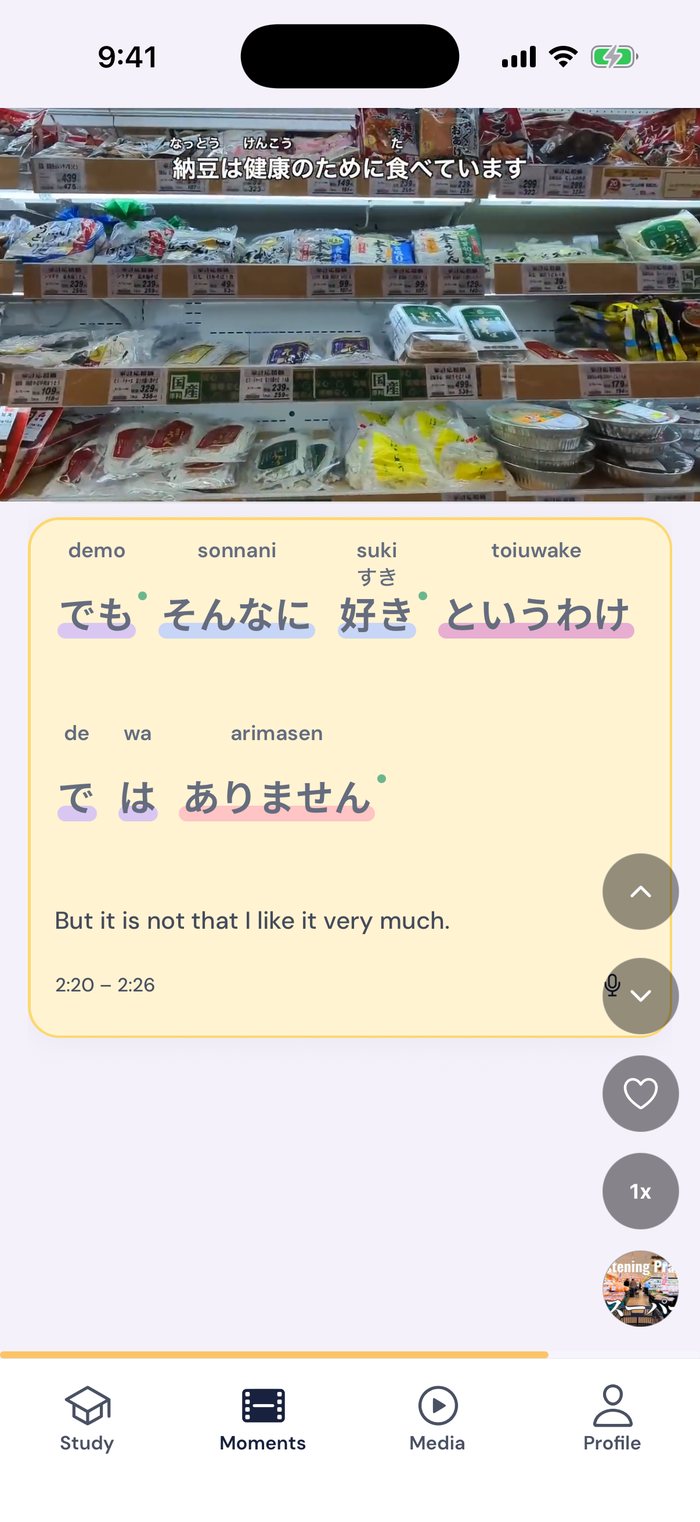
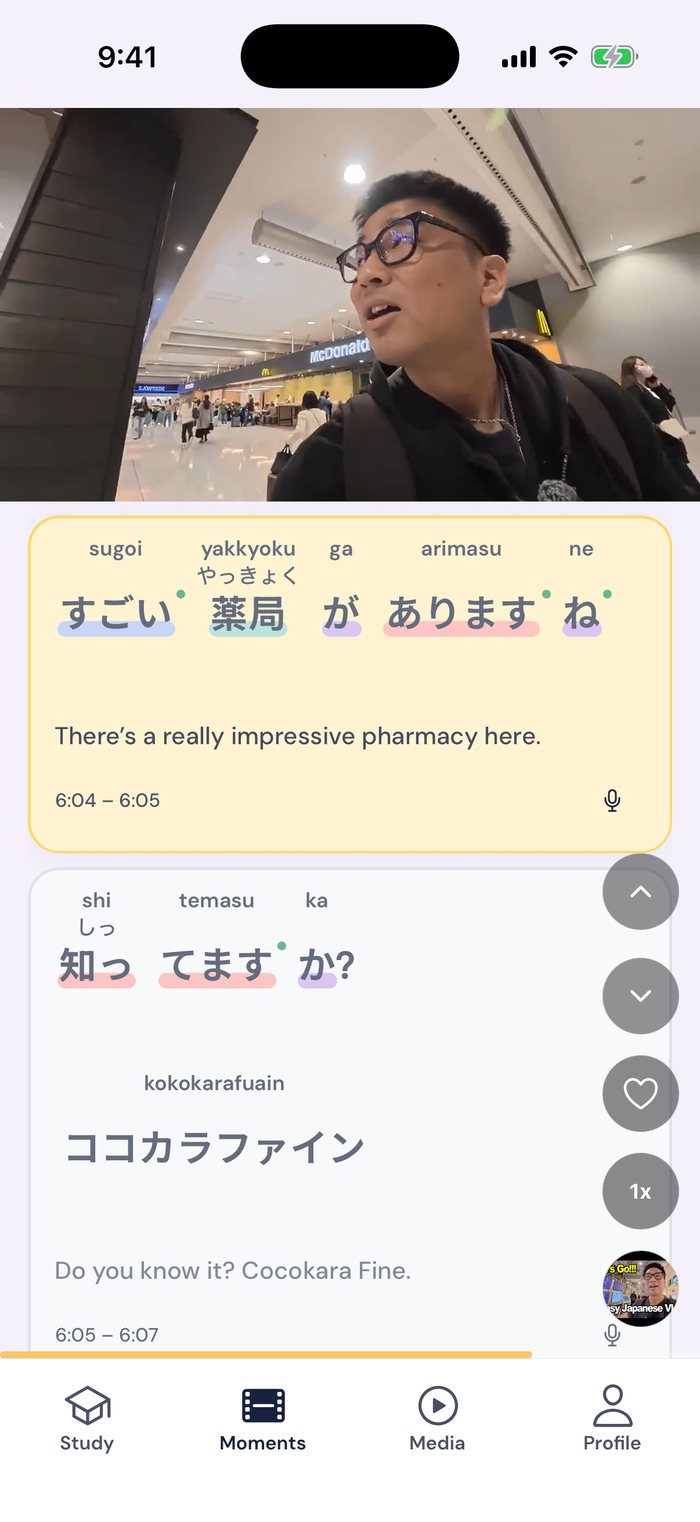
Speak Japanese Naturally and Japanese with Shun in Gravity, with every line timed word by word.
FAQ
What’s the best Japanese YouTube channel for complete beginners?
Nihongo no Jikan. Yuki speaks slowly about simple topics, and her Complete Beginner videos assume you know almost nothing. Speak Japanese Naturally is a good second channel once those feel comfortable.
Can you learn Japanese from YouTube alone?
Not well. YouTube gives you listening hours, but you still need grammar basics from something like Tae Kim’s guide or Genki, plus some vocabulary review. The two work best together.
Should I watch with English subtitles?
I’d avoid them. With English on screen you end up reading English and half-listening to Japanese. Use Japanese subtitles or a transcript instead, and check a translation only for the lines you can’t work out.
Where to start
Pick one channel at your level and one a level above, and watch a little of both most days. When the harder one starts feeling easy, move everything up a level.
If you’d rather do that on your phone with levelled videos and word-by-word transcripts, Gravity has a 7-day free trial on the App Store and Google Play.