
Podcasts are the easiest Japanese input to fit into a normal day. You can’t watch anime while you drive or wash dishes, but you can listen to someone talk about their weekend in slow, clear Japanese. No screen needed, and twenty minutes of listening hides inside a commute you were already doing.
Most of my podcast listening happened while cooking, walking across campus between classes at university, and driving. None of those needed my eyes, which is what makes podcasts so easy to fit in.
The hard part is the level. Too easy and you tune out; too hard and it turns into background noise. I went through the feeds of the most-recommended shows, checked which still put out episodes, and sorted them by level. Every pick was active or had a big archive as of September 2026.
Absolute beginner
Fair warning: in your first weeks, a Japanese-only podcast won’t make much sense. These two ease you in.
Japanese from Scratch with YUKO
Japanese from Scratch with YUKO is a weekly show for beginners who want to get used to the rhythm and basic vocabulary of Japanese. The topics are practical: hobbies, self-introductions, common mistakes, taking a taxi. Recent episodes run about 10 to 14 minutes. The catch: I couldn’t find transcripts, and a reviewer on Apple Podcasts wished for them too. I’d use it as a warm-up next to your textbook, not as your main study.
JapanesePod101
JapanesePod101 is the big commercial option, and it’s fairest to call it a course with a podcast attached. Lessons walk through a dialogue with English explanations, slowed-down audio and line-by-line breakdowns. A free account gets the first three lessons of every pathway plus new weekly lessons; the rest needs a paid plan. Its public podcast feed only gets one or two episodes a year, so treat that as a sampler. It suits you if you want hand-holding in English. Move on once you can follow easy Japanese on its own.
Beginner to lower intermediate (N5–N4)
Nihongo con Teppei for beginners
This is the one I’d start with. The beginner feed of Nihongo con Teppei (also on his site) has over 1,500 episodes, and most recent ones run about 4 to 6 minutes. Teppei talks about everyday things like supermarket Japanese, weekend walks and being full, all in Japanese. You can play one twice on the way to the store. “Beginner” still assumes some basics, though. One Apple reviewer at early N4 said they only caught a few words. When it gets easy, Nihongo con Teppei 波! is his newer show (it replaced Teppei Z in January 2025), with longer episodes.
Japanese with Shun
Japanese with Shun is the most structured pick at this level. Shun says he mainly uses grammar from Genki 1, with some from Genki 2, and he tags episodes N5–N4. Recent episodes run 10 to 14 minutes, with a new one every week or two, and transcripts are on his Patreon. He also runs Oyasumi Japanese with Shun, same level, made for listening before bed. If you’re working through Genki, this lines up nicely.
Intermediate (N3)
Here the pool gets bigger, so pick on personality.
Sayuri Saying: Everyday Japanese Podcast
Sayuri’s podcast comes out weekly, is aimed at intermediate learners, and has a relaxed pace. She talks about daily life in Japan, sometimes alone and sometimes with friends. Recent episodes run about 8 to 17 minutes, which makes it my pick for the first step up from Teppei. Transcripts, with or without furigana, are for paid members on her site.
Learn Japanese with Noriko
Noriko is a certified Japanese teacher, and her show is the most deliberate about pacing. She tells intermediate listeners to start at Season 1, where she speaks slowly and then speeds up, while Season 3 moves on to real-life dialogues and bigger topics. Transcripts for all three seasons are free on her site. That alone puts it near the top for me.
YUYU no Nihongo Podcast
YUYU no Nihongo is a long-running, all-Japanese show with over 500 episodes, pitched as radio for listening practice. Recent episodes run 30 to 50 minutes, so it’s a sit-back listen. The Patreon bills itself as the version with subtitles, and there’s a YouTube channel too. I’d put it at the upper end of N3.
The Bite size Japanese Podcast
Host Layla labels Bite size Japanese for N3–N2 learners, and she covers daily life, Japanese culture and study methods in natural Japanese. New episodes come out about twice a week, most around 20 to 30 minutes, with transcripts on Patreon. It’s a good bridge into the next tier.
Upper intermediate (N2 and up)
Haru no Nihongo
Haru no Nihongo puts the level in its title: N2–N1. Haruka talks about Japanese culture, news and everyday life, with recent episodes running 20 to 40 minutes. The transcripts are free on her site, which is rare at this level. It’s my top pick if you’re studying for N2.
Bilingual News
Bilingual News is a different animal. Michael and Mami go through the week’s news in an unscripted mix of English and Japanese, and the show pitches itself to learners of both languages. Episodes regularly run past an hour and a half, and there are over 700 of them. Transcripts are sold in their app, and the first three are free. It’s great for casual adult conversation about real topics, but too long to replay, so treat it as passive listening.
How to listen so it sticks
Background listening helps, but the gains come from a few focused minutes on top of it. With any show above:
- Replay the same episode. Listen once for the gist, once with the transcript, and once more without it. The third pass is where it clicks.
- Read the transcript after your first listen, not during. You want your ears doing the work first.
- Shadow two or three lines. Pause, repeat out loud, and match the rhythm. It feels silly and it works.
- Mine three to five words per episode, not thirty. Pick the ones you heard more than once. My sentence mining workflow covers how to turn them into cards.
For balancing active and passive input, see learning Japanese through immersion.
Tools that put a transcript in front of you
Wakatta is a Japanese podcast app that came to the App Store in July 2026. It works with over 5,000 shows from Apple Podcasts and RSS feeds, highlights the transcript word by word, and lets you tap a word for its meaning or ask an AI to explain a line. Saved words go into spaced-repetition review with the original audio. It’s free to start on iOS and Android, with a Pro tier for some features. If you want to stick with one of the shows above and read along, it’s the most direct option. It’s new, so I’d check a few transcripts against the audio before trusting them.
Full disclosure: we make Gravity, and it works differently. Gravity has a hand-picked library of Japanese YouTube videos, and it includes podcasts from YouTube, like Nihongo con Teppei and YUYUの日本語Podcast, next to anime clips, songs and vlogs. Each video is levelled from Pre-JLPT to N1, and we check every transcript before it goes live, then time it word by word with furigana or romaji and an English line under it. Tap a word, save it, and the flashcard can replay the clip you heard it in. There’s also 0.5x playback and a shadowing recorder. The trade-off: you can’t add your own shows. For more video picks, see my Japanese YouTube channels by level.
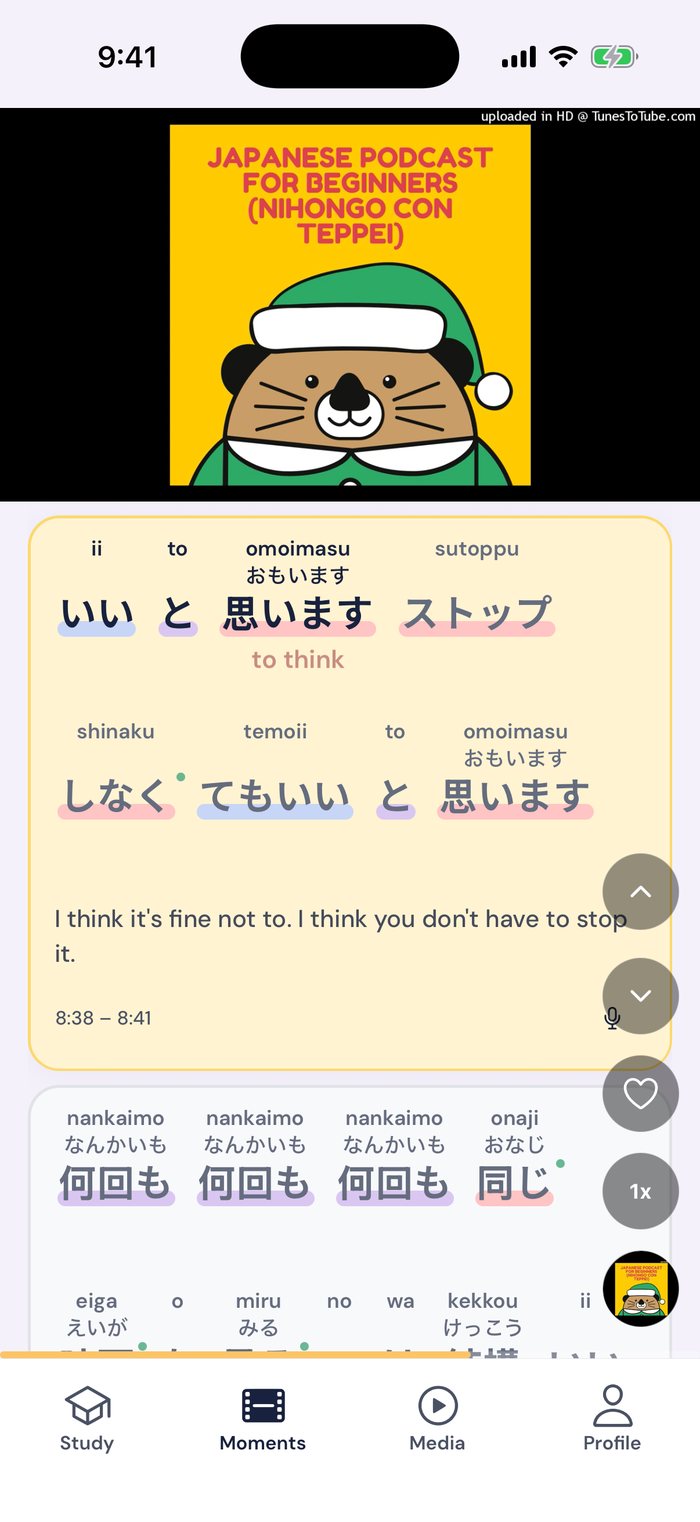
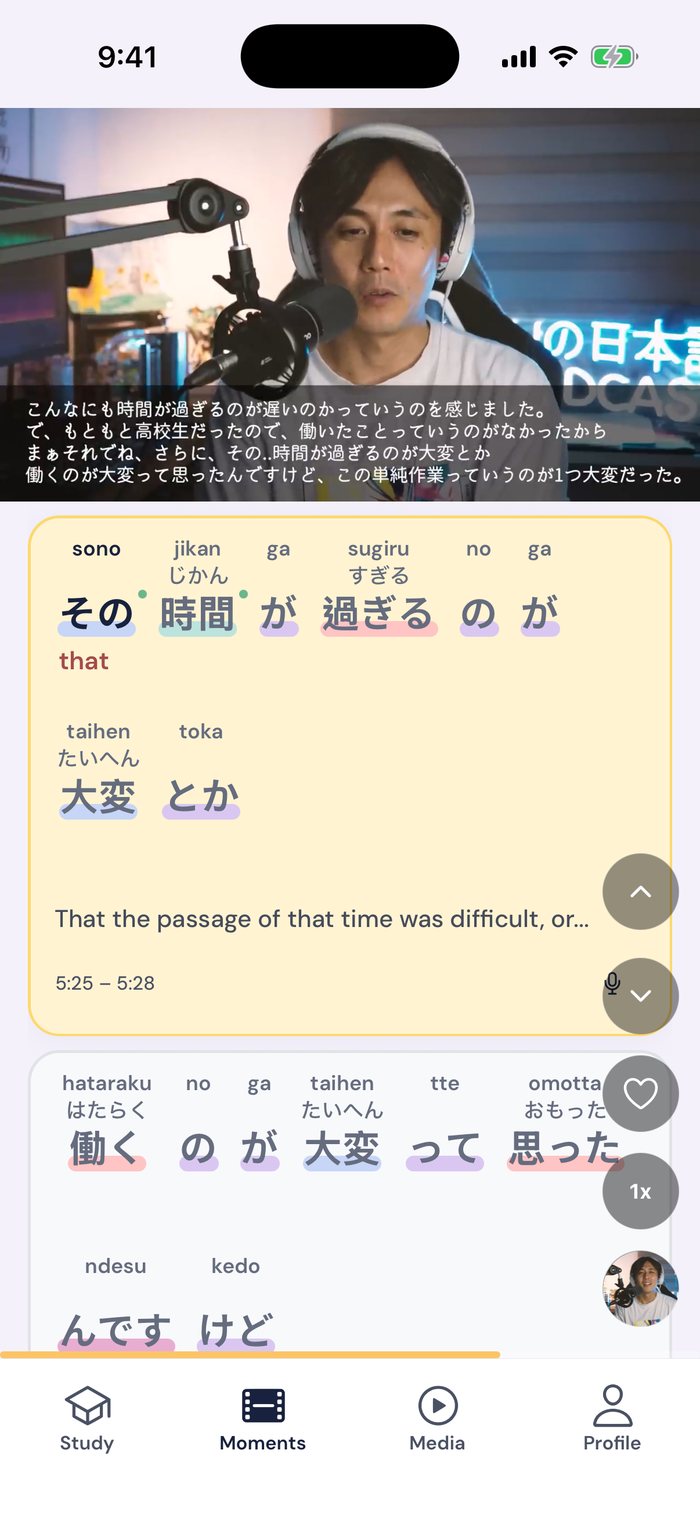
Nihongo con Teppei and YUYUの日本語Podcast in Gravity. You read along as they talk, and tap any word you miss.
FAQ
What’s the best Japanese podcast for complete beginners?
If you know some basic grammar, start with Nihongo con Teppei for beginners. The episodes are short, and there are enough of them to last a year. If you’re starting from zero, Japanese from Scratch with YUKO or JapanesePod101 will make more sense for the first month or two.
Which Japanese podcasts have free transcripts?
From this list, Learn Japanese with Noriko and Haru no Nihongo both post free transcripts on their sites. Japanese with Shun and Bite size Japanese put theirs on Patreon, YUYU’s Patreon offers a subtitled version, and Sayuri Saying and Bilingual News charge for theirs.
Where’s Nihongo no Jikan?
Yuki’s Nihongo no Jikan is built on comprehensible input, but it’s a video channel, not a podcast, so it belongs with the YouTube picks.
Start with one show
Don’t subscribe to all ten. Pick the one that matches your level, give it two weeks of daily listening, and replay episodes instead of chasing new ones. When it feels easy, move down the list.
If you’d like transcripts, levels and flashcards in one place, Gravity is on the App Store and Google Play with a 7-day free trial.