
If you’ve watched anime for a while, you already know a handful of Japanese words without ever studying them. すごい, やばい, 大丈夫, ごめん. That head start is worth using, because the same few dozen words come back in almost every episode, and each one you learn properly is one less line you need the subtitles for.
This list is the one I’d hand a friend who watches a lot of anime and wants to start understanding it. I didn’t count it from our own data. I picked the words characters say constantly, then checked them against jpdb.io, which tracks word frequency across roughly 1,400 anime (as of September 2026), so I can tell you which ones are everywhere and which ones are mostly an anime thing.
My own favourites for learning were slice-of-life shows like Toradora! and Bocchi the Rock!, and most of the words below come from everyday scenes like theirs, not only from fights.
How common are these words?
jpdb shows, for each word, how many anime in its database use it. ね and よ appear in every single one, all 1,399. 待つ shows up in 99% of them, 大丈夫 in 97%, and ありがとう in 96%. Numbers like these tell you the list is worth your time. They don’t tell you how a word feels, so the notes in each table are my take, checked against Tofugu and Jisho where the nuance is tricky.
Reactions
A lot of anime dialogue is somebody reacting to something. These are the first words you’ll catch without subtitles, and すごい alone appears in 93% of the anime jpdb tracks. Some of them lean hard on anime: マジ ranks around the top 500 words in jpdb’s anime data but only around 1,900 in books.
| Word | Meaning | How it’s used |
|---|---|---|
| え? (e) | Huh? What? | Probably the reaction you’ll hear most. A long, rising ええ?! means real shock. |
| すごい (sugoi) | Amazing, incredible | Safe with anyone. Guys in anime often slur it to すげー, which is casual. |
| やばい (yabai) | Dangerous, terrible, or amazing | Slang. It can mean “we’re in trouble” or “this is incredible”, and only the tone tells you which (Jisho lists both). Fine with friends, not with your boss. |
| マジ (maji) | Seriously, for real | Slang. マジで?! is “Are you serious?!”. Casual; keep it for friends. |
| ほんと (honto) | True; “For real?” | Short for 本当 (ほんとう). ほんとに? as a question is a safe everyday way to say “seriously?”. |
| うそ (uso) | A lie; “No way!” | As a reaction it means “no way”, not “you’re lying”. People say うそ! at good news too. |
| なるほど (naruhodo) | I see, that makes sense | The sound of a character piecing something together. Useful in real conversation as well. |
| さすが (sasuga) | As expected (of you) | Praise with a built-in compliment: you’re so good that of course you pulled it off. さすが先輩! |
Feelings and relationships
These carry most of the emotional scenes, and most of them are fine in normal life. The one to watch is 行くぞ, which sounds pumped-up and masculine because of the ぞ.
| Word | Meaning | How it’s used |
|---|---|---|
| 好き (すき, suki) | Like, love | Covers food, hobbies and people. 好きです is the classic confession line. |
| 大丈夫 (だいじょうぶ, daijōbu) | OK, all right | ”Are you OK?” and “I’m fine” in one word. In daily life it also means “no thanks”, per Jisho. |
| ごめん (gomen) | Sorry | Casual. ごめんなさい is softer and fuller; with strangers, use すみません. |
| ありがとう (arigatō) | Thank you | Add ございます for anyone you’d be polite with. |
| 待って (まって, matte) | Wait! | Shouted at someone walking away in almost every show. Casual; 待ってください is the polite version. |
| 行くぞ (いくぞ, iku zo) | Let’s go! Here I come! | Masculine. Gruff because of ぞ. 行こう is the neutral “let’s go”. |
| 頑張って (がんばって, ganbatte) | Do your best, hang in there | Encouragement before anything hard. The reply is 頑張ります, “I’ll do my best”. |
People and pronouns
This is where anime Japanese and real Japanese split the most. Anime characters say “I” and “you” constantly, and their choice of pronoun is part of their personality. Real people skip pronouns a lot and use names instead, as Tofugu’s guide to second-person pronouns explains. お前 makes the gap obvious: jpdb ranks it in the top 100 words for anime, but only around 1,600 for books.
| Word | Meaning | How it’s used |
|---|---|---|
| 俺 (おれ, ore) | I, me | Rough, masculine. Casual and manly; it can sound vulgar in formal settings (Tofugu). |
| 僕 (ぼく, boku) | I, me | Male-leaning but softer and more polite than 俺. The gentle or younger character’s pronoun. |
| お前 (おまえ, omae) | You | Rough, masculine. Affectionate between close friends, rude or angry otherwise (Tofugu). |
| あなた (anata) | You | The textbook “you”, and the most neutral one. Still, using someone’s name is usually better. |
| あいつ (aitsu) | That guy, him, her | Rough. Familiar at best, dismissive at worst. Fine about a friend, rude about a stranger. |
| 先輩 (せんぱい, senpai) | Senior at school or work | Used on its own or after a name. It’s a real, everyday word in Japanese schools and offices. |
| 〜さん (san) | Mr., Ms., neutral name ender | The default. When in doubt, use さん. |
| 〜くん (kun) | Name ender for boys, juniors | For equals or people below you, usually boys and men. Never for someone above you (Tofugu). |
| 〜ちゃん (chan) | Cute, close name ender | Kids, close friends, family, pets. Using it on a boss is like calling them “sweetie”. |
| 〜様 (さま, sama) | Very respectful name ender | Formal. Real life saves it for customers and formal emails; with friends it sounds over the top. |
Battle and drama words
Shōnen anime runs on these. They sound dramatic, but most are ordinary words. 守る also means “to keep” a promise or a rule, so 約束を守る is how anyone says “keep a promise”. jpdb finds 守る in 88% of the anime it tracks and 約束 in 80%.
| Word | Meaning | How it’s used |
|---|---|---|
| 守る (まもる, mamoru) | To protect; to keep (a promise) | Heroes protect people; everyone else keeps promises and follows rules. Both are normal Japanese (Jisho). |
| 仲間 (なかま, nakama) | Comrades, friends, teammates | The found-family word. In real life it’s plainer: coworkers, teammates, your group. |
| 約束 (やくそく, yakusoku) | Promise | Everyday word. 約束だよ is “It’s a promise, OK?”. |
| 絶対 (ぜったい, zettai) | Absolutely, definitely | 絶対に勝つ in a fight scene, 絶対おいしい about a cake. Useful everywhere. |
| 力 (ちから, chikara) | Power, strength | Any character with a secret power talks about 力. Normal word for physical strength and ability too. |
| 夢 (ゆめ, yume) | Dream | Both the goal kind and the sleeping kind. |
| 負けない (まけない, makenai) | I won’t lose | 負ける (to lose) in the negative. Sounds determined, and fine for a friendly game. |
| 諦めない (あきらめない, akiramenai) | I won’t give up | 諦める (to give up) in the negative. Real people say it about exams and diets too. |
Everyday lines
These set phrases barely translate, and anime is one of the best ways to learn when people say them. One surprise from jpdb: お疲れさま ranks around the top 400 words in live-action drama but only around 1,700 in anime. It’s an office word, and anime spends more time in classrooms than offices.
| Word | Meaning | How it’s used |
|---|---|---|
| おはよう (ohayō) | Good morning | Casual. Add ございます for teachers, bosses and strangers. |
| いただきます (itadakimasu) | Said before eating | Roughly “I gratefully receive”. Said before every meal. |
| 行ってきます (いってきます, ittekimasu) | I’m off (and I’ll be back) | Said when leaving home. The reply is 行ってらっしゃい, “see you, take care”. |
| ただいま (tadaima) | I’m home | Said walking in the door. |
| おかえり (okaeri) | Welcome back | The reply to ただいま. おかえりなさい is the fuller form. |
| よろしく (yoroshiku) | Nice to meet you; I’m counting on you | Hard to translate: it asks the other person to treat you well. よろしくお願いします is the polite version. |
| お疲れ様 (おつかれさま, otsukaresama) | Thanks for your hard work; see you | Said to coworkers or teammates after work or practice. お疲れ! is the casual form. |
Endings and particles
Small words at the end of a line change its whole tone, and they include the most frequent words on this list. jpdb finds ぞ in 99% of the anime it tracks, and ぜ ranks around the top 500 in anime but only around 3,700 in books.
| Word | Meaning | How it’s used |
|---|---|---|
| ね (ne) | Right? Isn’t it? | Looks for agreement. いい天気だね, “Nice weather, huh?”. Use it all the time. |
| よ (yo) | You know; I’m telling you | Marks something the listener doesn’t know yet. Overdo it and you sound pushy. |
| ぞ (zo) | Adds force, or a command | Masculine. Tagged as male speech on Jisho. Sounds gruff; skip it until you know who you’re talking to. |
| ぜ (ze) | Light emphasis | Masculine. Tagged as male speech on Jisho. 行こうぜ is the cool-guy “let’s go”; in real life it can come off like a put-on. |
| かな (kana) | I wonder | Softens a guess or a question to yourself. 雨かな, “Rain, maybe?”. Natural and neutral. |
| だろう (darō) | Probably; “right?” | Clipped to だろ, it sounds blunt. でしょう is the polite version you’ll want. |
| じゃん (jan) | Isn’t it? Come on | Slang. Casual, from じゃないか (Jisho). Friends only. |
Words that sound cool in anime but you shouldn’t use with real people
Anime characters are loud, rude and dramatic on purpose. Copy their speech straight into a conversation and you’ll sound like a villain, or like someone who learned Japanese only from anime (which people will notice right away). These are the ones I’d keep for watching:
- お前 (omae). Among close friends it’s normal. With anyone else it comes across as rough and rude.
- 貴様 (kisama). It was once polite. Now it’s an insult, and Jisho glosses it as “you bastard”. Villains love it.
- てめえ (temē). Even harsher than お前, and tagged derogatory on Jisho. It’s mostly a fight-scene word.
- 俺様 (oresama). 俺 plus 様, roughly “my magnificent self”. Jisho also lists it as a noun for a pompous, self-centred man, and I’d only ever say it as a joke.
- 〜様 on friends. Calling a classmate 〜様 sounds like you’re their butler.
- ぞ, ぜ and だろ at the end of every line. Fine now and then. Stacked together with 俺 and お前, you sound like a delinquent from a 90s manga.
Tofugu’s guide to second-person pronouns sums up the bigger point: Japanese people use names and roles far more than “you”. If you want to sound natural, say the person’s name with さん.
How to learn these words
A list gets you started. It won’t make the words stick. What works is hearing each one in a scene, saving it with that scene, and reviewing it a few days later.
- Hear them in context. Watch with Japanese subtitles or a transcript, so you see the word as you hear it. Our guide to learning Japanese with anime covers which shows to start with and how to watch them.
- Save the sentence, not only the word. さすが by itself is flat. さすが先輩 in the scene where a senior pulls off something impressive is memorable.
- Review on a schedule. A spaced repetition deck brings each word back right before you forget it. Our sentence mining workflow walks through the full routine.
FAQ
What does やばい mean?
It depends on the tone. The original meaning is “dangerous” or “bad”, as in “we’re in trouble”, but in casual slang it can also mean “amazing”. Jisho lists both. It’s slang, so keep it for friends.
Is it rude to say お前?
Often, yes. Tofugu describes お前 as masculine and rough. Close friends use it with each other, but with anyone you don’t know well it comes across as rude. Use their name with さん instead.
Which of these words are the most common?
The particles. On jpdb, ね and よ appear in every one of the roughly 1,400 anime it tracks, and ぞ, かな and だろう are close behind. For actual vocabulary, words like 待つ, 大丈夫 and ありがとう show up in well over 90% of them.
Learn them from the scenes themselves
These words stick fastest when you hear them in a real line and see them in writing at the same time. That’s what we built Gravity for. The library includes anime clips, alongside music, podcasts and vlogs, with transcripts timed word by word. Moments is a feed of short clips you scroll like any short-video app: tap a word you don’t know, save it, and keep going. Every saved word becomes a flashcard that replays the clip you found it in, so やばい comes back with the scene attached.
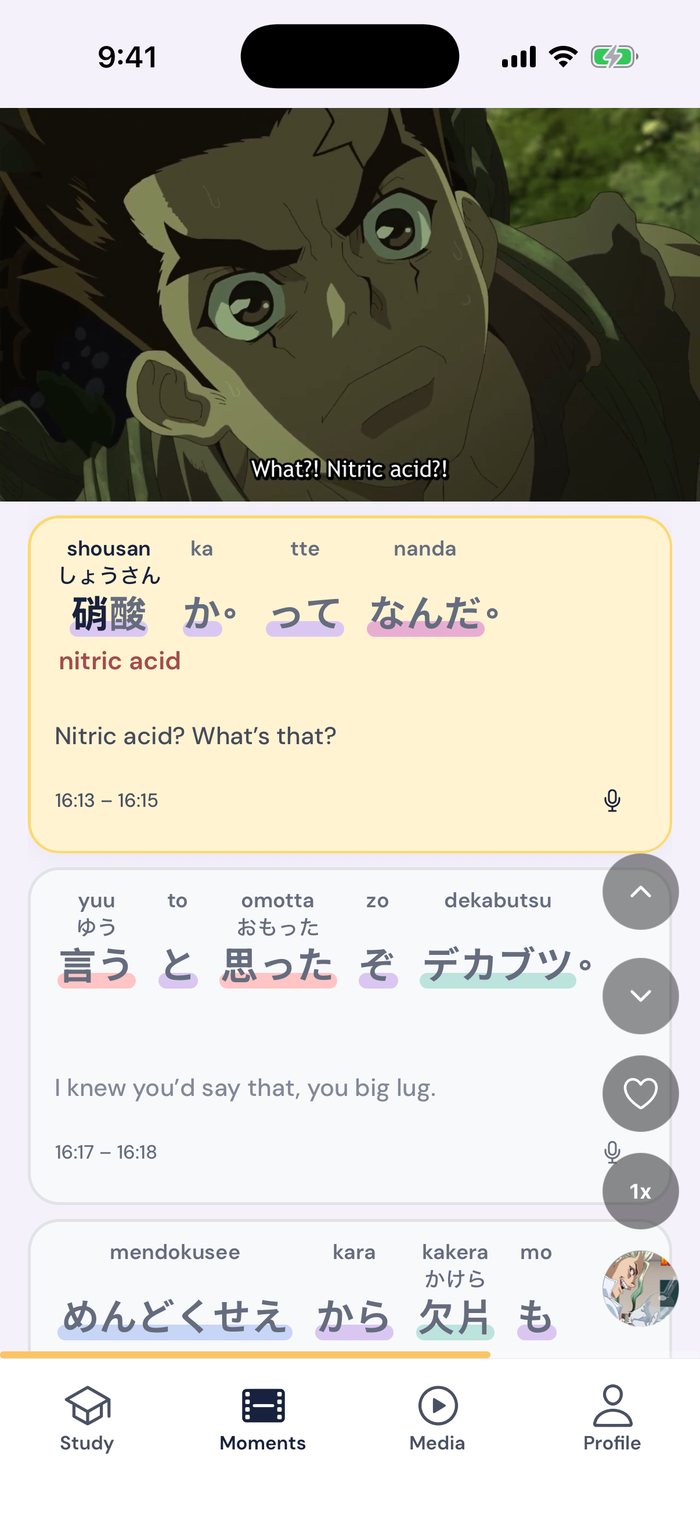
俺 and てめえ in a single line, from a Dr. Stone clip in Gravity’s Moments feed.
Gravity has a 7-day free trial on the App Store and Google Play.