A lot of people who start Japanese have already watched hundreds of hours of anime. Many of them also notice, at some point, that all those hours left them with すごい, やばい, and not much else.
The problem is the English subtitles, which turn a Japanese lesson into a reading exercise in English. Change how you watch, pick the right shows, and anime becomes one of the best sources of real, spoken Japanese you’ll find.
Why English subtitles don’t teach you much
When English text is on screen, you read it, and the Japanese audio turns into background music.
In a study by Mitterer and McQueen (2009), Dutch listeners watched Scottish and Australian English with English subtitles, Dutch subtitles, or none. English subtitles helped them make out new lines in that accent afterwards. Dutch subtitles, in their own language, hurt it.
Subtitles in the language you’re learning (researchers call them captions) do better. A meta-analysis by Montero Perez, Van Den Noortgate and Desmet (2013) pooled studies on captioned video and found a clear, large effect on both listening comprehension and vocabulary. A later study by Peters, Heynen and Puimège (2016) found that captions helped learners pick up the form of new words (how they look and sound), and that the group with native-language subtitles didn’t beat them on meaning either.
The catch: gains from watching alone were small. Peters and Webb (2018) found learners were more likely to pick up words that came up again and again. So rewatch scenes, and save the words you want to keep instead of waiting for them to sink in.
One caveat: most of this research is on European languages. For Japanese, kanji subtitles you can’t read won’t help much, so a transcript with furigana, or subtitles you can pause and look up, works better.
Which anime to start with
Pick shows where people talk about ordinary things like food, school, and family, because you’ll hear that Japanese everywhere else. Battle shows teach you attack names and words like 魔力 that you’ll rarely need outside the show.
- Chi’s Sweet Home: a lost kitten taken in by a young family, told in episodes of about three minutes (104 in the first season alone). You can rewatch one five times in a quarter of an hour.
- Shirokuma Cafe: 50 episodes about a polar bear who runs a cafe, and the panda and penguin who hang out there. Slow, casual chat between friends.
- Yuru Camp (Laid-Back Camp): high school girls go camping in and around Yamanashi. Calm dialogue about food, gear, and plans.
- Doraemon: the current series has aired on TV Asahi since 2005, and each episode splits into short, self-contained stories about a robot cat helping a boy named Nobita. Plain family and school Japanese.
- Spy x Family: a spy builds a fake family, not knowing his daughter reads minds and his wife is an assassin. The family scenes are great everyday listening; the spy scenes are harder.
- Frieren: save this one for later. The pace is slow and the delivery is calm, which helps, but it’s a fantasy about an elf mage, so plenty of the vocabulary is magic and demons.
One I’d hold off on: Barakamon. It’s lovely, but Naru, one of the main characters, speaks Gotō Islands dialect, which the creator kept in the anime because her young voice actor spoke it so well. Great for the show, confusing for a beginner.
My own favourites for learning were slice-of-life shows like Toradora! and Bocchi the Rock!. They’re mostly high school kids talking about crushes, lunch, and band practice, which is the Japanese you keep hearing everywhere else.
If you want more easy shows and podcasts sorted by level, my immersion guide has a longer list. Anime openings count too, and I cover those in learning Japanese with songs.
Anime Japanese isn’t how people talk
Anime characters talk in character. That’s part of the fun, but don’t copy it wholesale.
- 俺 and お前. Plenty of male leads in anime call themselves 俺 and everyone else お前. Tofugu describes 俺 as strongly masculine and casual, and お前 as rough and often paired with vulgar language, though it can be affectionate between close friends. In real life, people usually skip “you” and use the person’s name or role instead.
- Character voices. Anime old men often end sentences with じゃ, samurai say ござる, and some characters repeat a catchphrase constantly. As Tofugu’s guide to learning from anime puts it, be careful not to copy characters who don’t sound like people.
- Not much keigo. Most anime happens between friends, family, and rivals, so you hear little of the polite Japanese you’d use with a shopkeeper or a boss. You’ll need a textbook or real-life content for that.
None of this is a reason to skip anime. Understand 俺 when you hear it, and say 私 in a job interview.
A simple routine
This takes about 20 minutes, one scene at a time.
- Pick a scene of 2 to 3 minutes from a show you like.
- Watch it with Japanese subtitles or a transcript. Pause on each line you don’t follow.
- Save 3 to 5 words. Pick ones you think you’ll hear again, and save them with the sentence they came from.
- Rewatch the scene once or twice until you can follow it without pausing.
- Review your cards the next day with spaced repetition.
Three to five words doesn’t sound like much, but do it most days and that’s around 100 words a month, each tied to a scene you remember. I go deeper on the saving and reviewing part in my sentence mining workflow.
Tools that help
- asbplayer is a free, open-source browser extension and player. It loads subtitles onto streaming video, including subtitle files you supply, and turns lines into Anki cards. It takes some setup, but it’s the most flexible free option.
- Language Reactor is a Chrome extension that shows two subtitle tracks at once on Netflix and YouTube, with a free tier and a paid Pro mode. Put the Japanese track on top and hide the English one until you need it.
- Migaku makes cards from Netflix in one click on a computer, and I compare it with Gravity in Gravity vs Migaku.
A warning about Netflix: Japanese subtitles aren’t on every title. Netflix says subtitle languages depend on the title and where you’re watching from, because of licensing, so a show can have Japanese subtitles in one country and not in another.
And yes, we make Gravity, which is built for this kind of watching on a phone. Its hand-picked library of Japanese YouTube videos includes anime clips, levelled from Pre-JLPT to N1, with checked transcripts timed word by word. Moments is a feed of short clips where you tap a word, save it, and keep scrolling, and each flashcard replays the clip you found the word in. It doesn’t work with Netflix and you can’t add your own videos, so for mining a whole series, asbplayer or Migaku fits better.
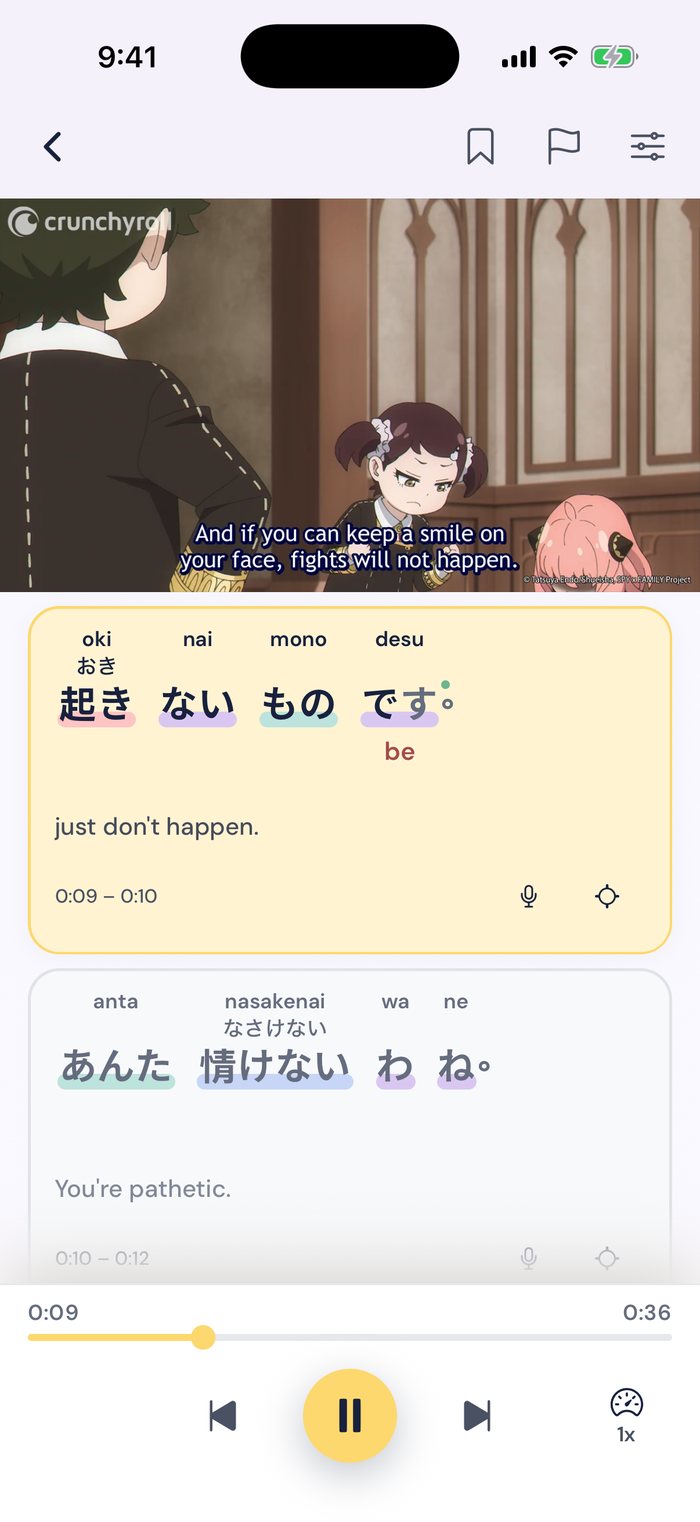
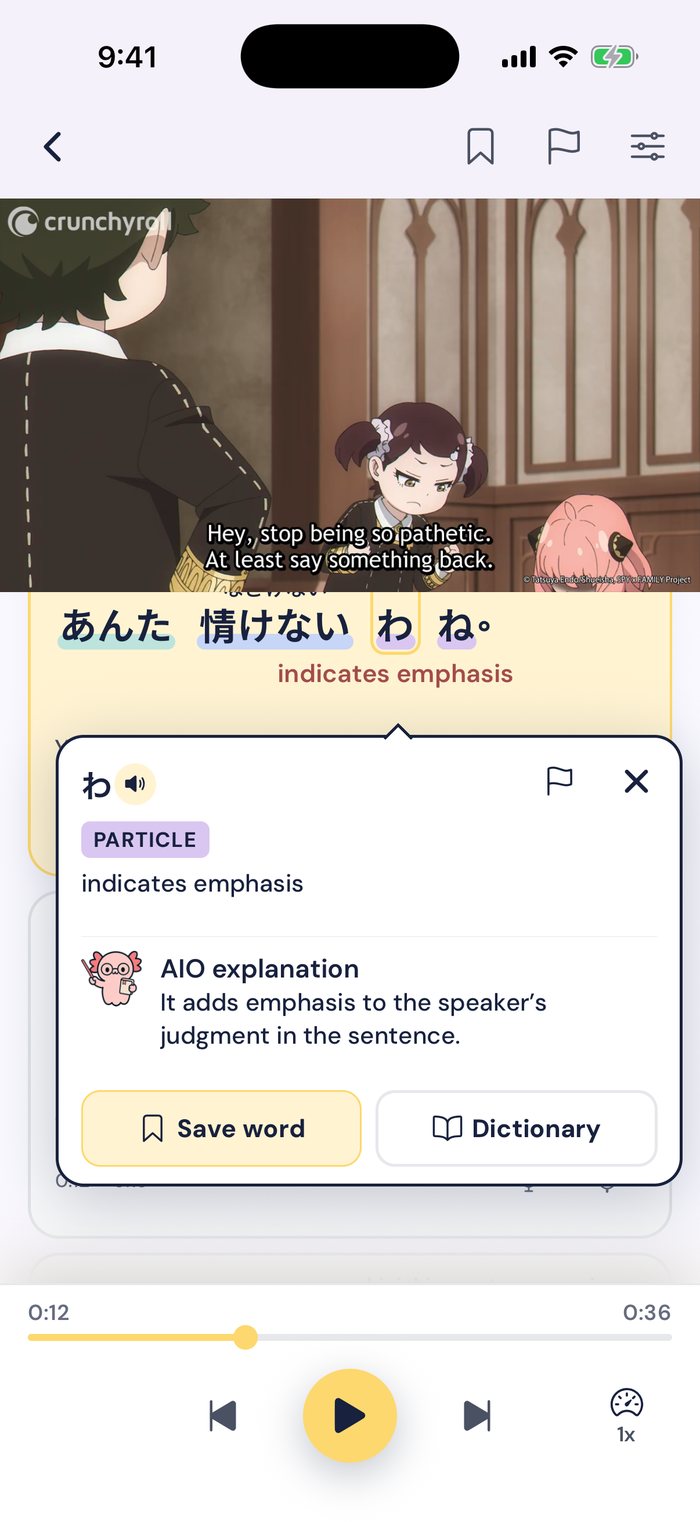
A Spy x Family clip in Gravity. Tap any word, like the particle わ, and Aio explains what it’s doing in that line.
FAQ
Can you learn Japanese from anime alone?
Not well. Anime gives you listening practice and vocabulary, but it won’t teach you grammar or polite speech. Pair it with a grammar guide like Tae Kim’s.
What’s the best anime for Japanese beginners?
I’d start with Chi’s Sweet Home or Shirokuma Cafe. Both are slow, everyday, and short enough to rewatch. Move to Yuru Camp or Doraemon once those feel easy.
Should I watch anime with Japanese or English subtitles?
Japanese, or a transcript with furigana if you can’t read the kanji yet. The research favours subtitles in the language you’re learning. English subtitles are fine for relaxing, but don’t count those hours as study.
Is it rude to talk like an anime character?
Sometimes, yes. 俺 and お前 can sound rough or rude with people you don’t know well, and character speech styles sound odd in real conversation. Use what you hear to understand people, and learn polite forms separately.
Summing up
Anime works when you treat it as listening practice: Japanese subtitles, short scenes, a handful of saved words, and regular review. Start with slice-of-life, then move to the shows you love.
If you want anime clips with checked transcripts and tap-to-save flashcards on your phone, Gravity has a 7-day free trial on the App Store and Google Play.