

Songs are the one kind of Japanese most learners already listen to for fun. You put on Lemon or 打上花火 because you like it, and a few weeks later you can sing a line you never tried to memorize. For a learner, that’s a great place to start.
The catch is that lyrics are a strange version of Japanese. They’re poetic, they skip grammar, and they read kanji in ways you’d never hear in a café. So I treat songs as a memory tool and a pronunciation coach, and I’d never use them as a grammar textbook.
Full disclosure: we make Gravity, and two of the songs below are in its library. Every song link goes to an official video on the artist’s, label’s or broadcaster’s channel.
Why songs work
The best evidence I found is a 2014 study in Memory & Cognition by Ludke, Ferreira and Overy, Singing can facilitate foreign language learning. Sixty adults learned phrases in Hungarian, a language unfamiliar to them, during a 15-minute listen-and-repeat session. One group spoke the phrases, one spoke them to a rhythm, and one sang them. The singers did best overall, and the gap was statistically significant on the two tests where people had to recall the phrases and say them out loud.
It’s one small study, and it tested short phrases, not fluency. It still matches what most learners notice: a melody gives words something to hang on. I’d add three more reasons.
- Rhythm and sound. Japanese pop tends to give each syllable its own note, so singing along trains you to hold long vowels and the small っ pause that English speakers tend to squash.
- Feeling. A word from a song you love comes with a mood attached, and that makes it easier to recall. It’s the same reason immersion works better than word lists.
- Free repetition. You’ll replay a favourite song fifty times without it feeling like study.
What to watch out for
Lyrics are poetry, and poetry bends the rules. These are the traps I’d flag for anyone learning from songs.
- Missing particles. Lyricists cut は, を and が to fit the melody, so lines often read like a string of nouns. You’d say 空を見上げる in normal speech, but a lyric might drop the を.
- Unusual readings. Songwriters often write one word and sing another, with the sung reading printed as furigana. 運命 sung as さだめ, 地球 as ほし, and 本気 as マジ are all common. Learn the sung reading and you’ll get the word wrong on a test.
- Pronouns and tone. Songs lean hard on 僕 and 君. In daily conversation, calling someone 君 can sound distant or a bit presumptuous, and most people use the person’s name.
- Rare words. Pop lyrics love words like 刹那 (a fleeting moment) and 儚い (fragile, short-lived) that you’ll rarely hear in a shop.
- Bent pronunciation. The melody overrides pitch accent and stretches vowels, so don’t copy intonation from songs.
My rule: take vocabulary and sound from songs, and take grammar from a grammar source like Tae Kim’s guide.
Japanese songs from easiest to hardest
I ranked these by tempo, how clear the vocals are and how poetic the lyrics get.
Easiest: kids’ songs
- アンパンマンのマーチ (Dreaming), the opening theme of the kids’ anime Soreike! Anpanman. It has a march tempo, simple words and clear singing. The honest note: kids’ songs get dull fast, and no adult talks like them. Use them as a warm-up.
- パプリカ (Foorin). NHK asked Kenshi Yonezu to write it as a cheer song for the 2020 Olympics, and a children’s group sings it. The kids sing clearly, but Yonezu’s lyrics are more poetic than they sound.
Easy: slow and clear
- チェリー (Spitz). A 1996 classic with an easy-going tempo, everyday words and Masamune Kusano’s clear, soft voice. This is where I’d start.
- マリーゴールド (Aimyon). A 2018 hit with relaxed phrasing that sits close to speech, and a chorus that sticks after a few listens.
- Lemon (Kenshi Yonezu). The 2018 theme song of the TV drama Unnatural. It’s slow and clearly sung, but the words about grief and memory get literary, so it sits at the top of this group.
Medium
- 打上花火 (DAOKO × Kenshi Yonezu). The theme of the 2017 anime film Fireworks. Two voices trade lines, and DAOKO’s soft, breathy delivery is harder to catch than Yonezu’s. It’s in Gravity’s library, and it pairs well with learning Japanese from anime.
- 新宝島 (Sakanaction). The theme of the 2015 live-action Bakuman film. It’s faster, but the chorus repeats a lot, which helps. Also in Gravity.
Hard
- ただ君に晴れ (Yorushika). The vocals are clear, but Yorushika’s lyrics are dense with imagery and literary words. Great once you’re comfortable reading.
- アイドル (YOASOBI). The opening of Oshi no Ko. It’s fast, has rap-style sections and switches between several points of view. I’d save it for last.
If you want my pick, it’s 新宝島. The chorus repeats so much that you’ll know a good chunk of it after a few listens.
A one-week routine for one song
Pick one song you like and give it a week. That’s enough to own it without burning out.
- Day 1, listen. Play it twice without lyrics and notice which words you already catch.
- Day 1 or 2, read. Go through the lyrics line by line with furigana and a translation.
- Day 2, pick 3 to 5 words. Don’t look up everything. Choose words you’d use outside the song, skip the poetic ones, and save each with its full line. My sentence mining workflow covers how.
- Days 3 to 5, sing or shadow. Play a line, pause, repeat it. Slow the track down for fast parts, then sing along at full speed.
- Days 6 and 7, test yourself. Listen without lyrics and see how much you catch now. Then move on, and come back in a month.
Where to get lyrics legally
Uta-Net (歌ネット) is a Japanese lyrics search site where you can search by artist, song title or lyricist, and its pages carry JASRAC and NexTone licence marks. The site is in Japanese, so paste kanji you can’t read into a dictionary like Jisho.
Streaming apps work too. Spotify shows real-time lyrics to free and Premium users, though not on every song or in every market. Apple Music subscribers get a Translation and Pronunciation button that shows a translation or phonetic pronunciation on some songs, depending on language and region.
I’d skip fan-made lyric videos. Many aren’t licensed, and the furigana are hit or miss.
Learning songs in Gravity
Gravity’s library mixes music and songs with anime clips, podcasts and vlogs, and songs get a sing-along lyric view. Lyrics are timed word by word, with furigana or romaji, an English translation for each line and each word’s meaning underneath. Tap a word for its meaning, and Aio, our axolotl, can explain what it means in that exact line. Tap Save word to make it a flashcard, and the card’s Memory tile replays the clip you found it in.
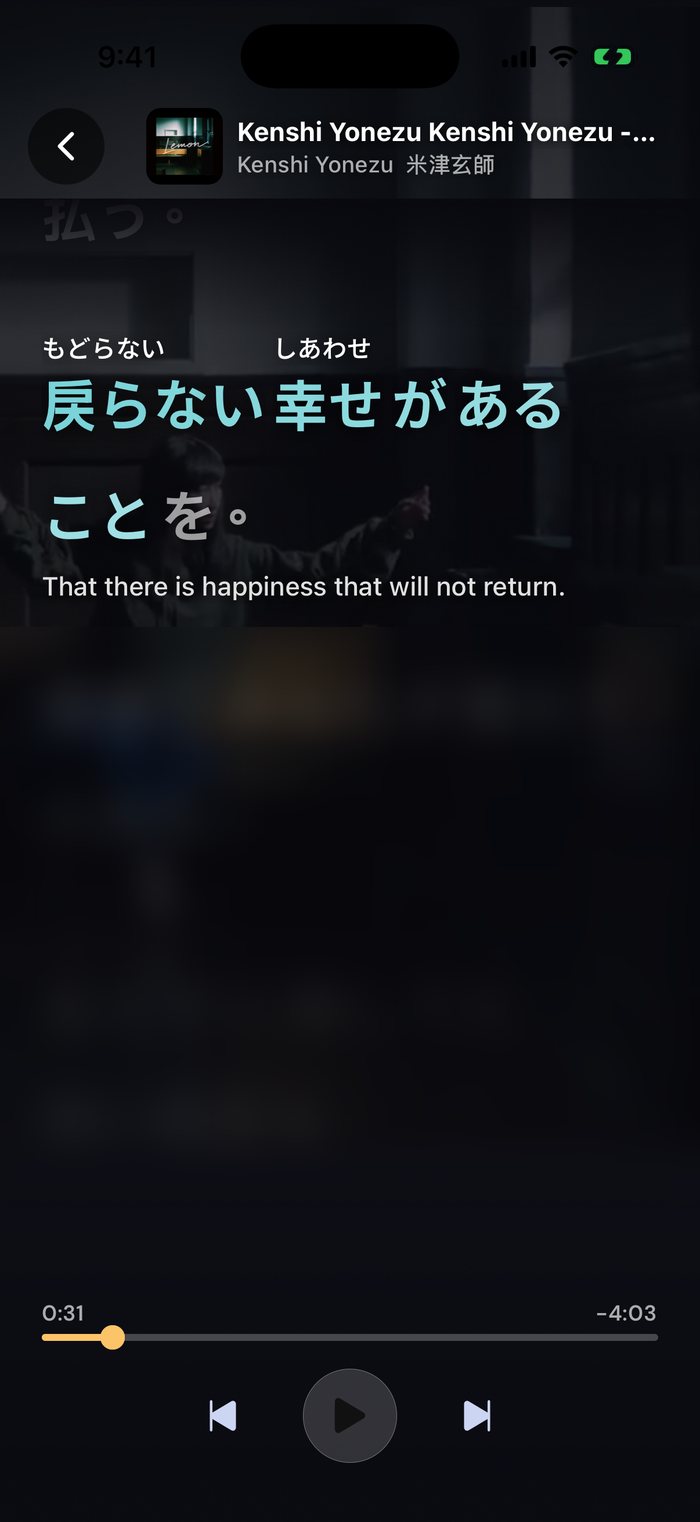
Karaoke mode in Gravity with Kenshi Yonezu’s Lemon. The line being sung lights up, with furigana and a translation under it.
For fast sections you can drop playback to 0.5x, and the shadowing recorder lets you record yourself and compare. 打上花火 and 新宝島 are both in there. Gravity doesn’t teach grammar, so pair it with Tae Kim or Genki.
FAQ
Can you learn Japanese from songs alone?
No. Songs build vocabulary, listening and pronunciation, but they won’t teach you how people talk day to day. Pair them with a grammar guide and plenty of spoken Japanese, like podcasts, YouTube or anime.
What’s the easiest Japanese song for beginners?
Kids’ songs like アンパンマンのマーチ are the simplest, but they get boring. For a song you’ll want to replay, I’d start with Spitz’s チェリー or Aimyon’s マリーゴールド: both have a comfortable tempo and clear vocals.
Are anime songs good for learning Japanese?
Some are. Openings tend to be fast and dense, and アイドル is a good example of one to save for later. Film themes like 打上花火 are gentler. Treat them like any other song: learn the words, not the grammar.
Summing up
Songs are the best memory aid I know for Japanese, and they train your ear and mouth at the same time. Keep grammar out of it: pick one song, give it a week, save a handful of words, and move to the next.
Gravity has a 7-day free trial on the App Store and Google Play.